"In future-facing industries, innovation is indispensable.
But how do you create security in the process?
Pilot Blue serves as a trusted navigator — reducing financial risk for first adopters and unlocking opportunities where others still see barriers."
Our pilot program
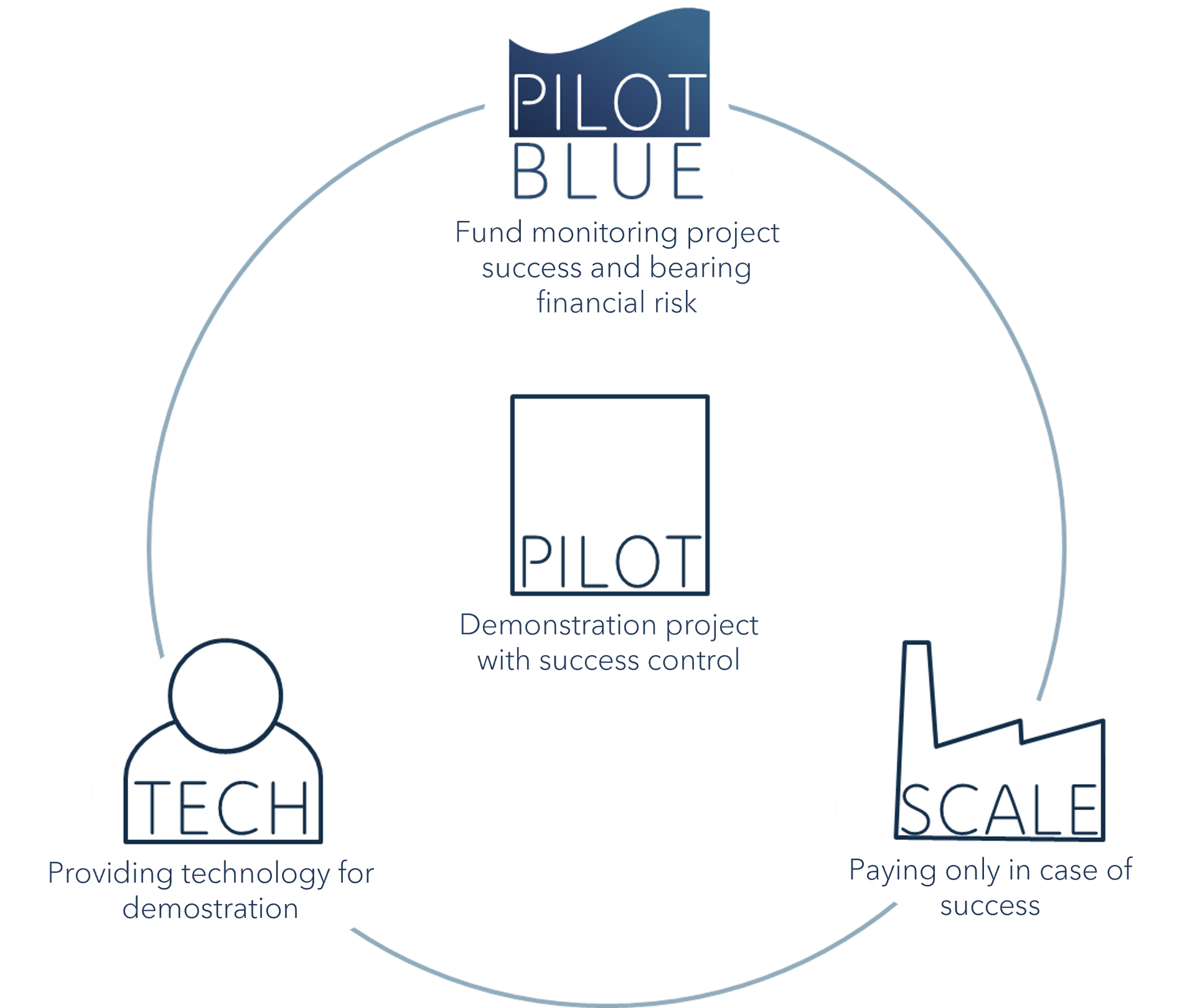





Projects that drive change
At Pilot Blue, the focus is not on research or experimentation for its own sake, but on tangible value creation. Our projects demonstrate market relevance by deploying technologies directly at the customer’s site over a period of approximately two to nine months. When performance targets are achieved, full-scale implementation follows.
Our funding is directed at stakeholders in the environmental and circular economy sectors across the German-speaking region, whether municipal or industrial. We prioritize technical and digital solutions that are modular, resilient, and scalable—because we are convinced that this is where the answers to our industry’s most pressing challenges will emerge.




Frequently asked questions
What is a pilot project?
A pilot project involves testing an innovative, market-ready technology directly at the user’s site to establish the basis for potential large-scale deployment or adoption. For this purpose, the product or system is typically provided to the user on a temporary basis for a trial period ranging from several weeks to a few months. During this phase, different operating conditions are evaluated, performance data is analyzed, and potential optimizations are identified. The costs of such a pilot project generally range between €10,000 and €50,000 and is covered by Pilot Blue in the event that the project does not achieve the agreed objectives.
What is the purpose of a pilot project?
A pilot project is not intended for basic research or early experimentation. Its purpose is to demonstrate the performance of a market-ready technology in a clearly defined, real-world application. To achieve this, the developer provides a system or product that is tested directly in the client’s operational environment. The objective is to validate technical feasibility and refine key design and operational parameters for subsequent large-scale implementation.
Which prerequisites must be met?
Two prerequisites are essential for initiating a pilot project: the technology must already be market-ready, and the participating user must have a genuine interest in adopting the product or system at full scale if the agreed success criteria are met.
For this reason, we place strong emphasis on defining transparent and measurable success criteria before the project begins, ensuring that the operator has a clear and reliable decision framework. Equally important is the systematic documentation of test results and their transparent sharing within the project team —under appropriate confidentiality agreements— to enable an objective evaluation of the technology.
In principle, our pilot program is open to all application sectors, technology domains, and project teams, although we prioritize projects implemented within Europe.
Who takes on which roles in the project?
Successful pilot projects require active participation from all parties involved. The technology provider supplies a suitable test unit and typically assumes responsibility for commissioning, maintenance, and technical oversight throughout the project period. After an initial training by the provider, the participating user operates the technology independently during the pilot phase and generally conducts the sampling and analytical measurements.
Pilot Blue acts as the program coordinator, responsible for project planning, evaluation of results, contractual structuring of the collaboration, and provides financial risk mitigation. Where appropriate, additional partners may be involved, such as external laboratories, universities, or engineering firms.
How does Pilot Blue support your project?
Pilot Blue coordinates the pilot project between technology provider and user as an independent third party. We work with all stakeholders to plan the pilot operation, define the success criteria, ensure that the agreed framework conditions are maintained, and evaluate the results at the conclusion of the project.
If the defined success criteria are not met, Pilot Blue assumes the costs of the pilot phase. This ensures that neither the technology provider nor the potential customer carries financial risk during the demonstration.
How is project success measured?
The outcome of a pilot project forms the basis for a potential long-term adoption of the technology. For that reason, a neutral, transparent, and data-driven evaluation process is essential.
Prior to the start of the project, quantitative performance targets are defined for key parameters such as efficiency, energy consumption, resource savings, maintenance intervals, or similar operational indicators. Only if these criteria are met during the pilot phase is the project considered successful, triggering the customer’s commitment to adopt the technology.
Which costs are covered by Pilot Blue if the project fails?
If a pilot project does not achieve the predefined targets, Pilot Blue assumes the project costs incurred. This includes, in particular, the rental fees for the pilot system as well as expenses for operating chemicals, energy, and other consumables or material inputs. Depending on the specific project setup, costs related to commissioning and operator training provided by the technology supplier, as well as external laboratory analyses, may also be considered. Personnel costs incurred on the operator’s side for running the pilot are treated as an in-kind contribution and are therefore not included in the covered project expenses.